CALL US TODAY

Concreters you can trust.
CALL US TODAY
Fresh concrete may appear solid soon after it is poured, but it still needs time to cure before it can safely handle regular use. Con-Tek Concrete helps property owners understand why allowing sufficient curing time is an important part of achieving a durable, long-lasting finish. Experienced concreters in Hobart consider factors such as slab thickness, weather conditions, concrete mix and the type of load the surface will eventually support when determining when new concrete can be used.
Walking, driving or placing heavy items on concrete too early can increase the risk of surface marks, cracking and premature wear. This article explains the typical waiting periods for foot traffic, vehicles and heavier loads, along with the main stages of concrete curing and the conditions that can affect the process. It also covers what homeowners can generally expect for driveways, patios and pathways, helping them protect new concrete during its critical early stages.
New concrete gains strength relatively quickly but remains vulnerable during its first few days. Knowing when it is safe to walk, park or drive on it can help prevent unnecessary surface damage and cracking.
The following timeframes provide a practical guide for typical residential driveways, paths and patios placed in moderate conditions using standard concrete mixes. Actual curing times can vary depending on temperature, mix design, slab thickness and site conditions, so advice from the concreter or engineer responsible for the project should always take priority.
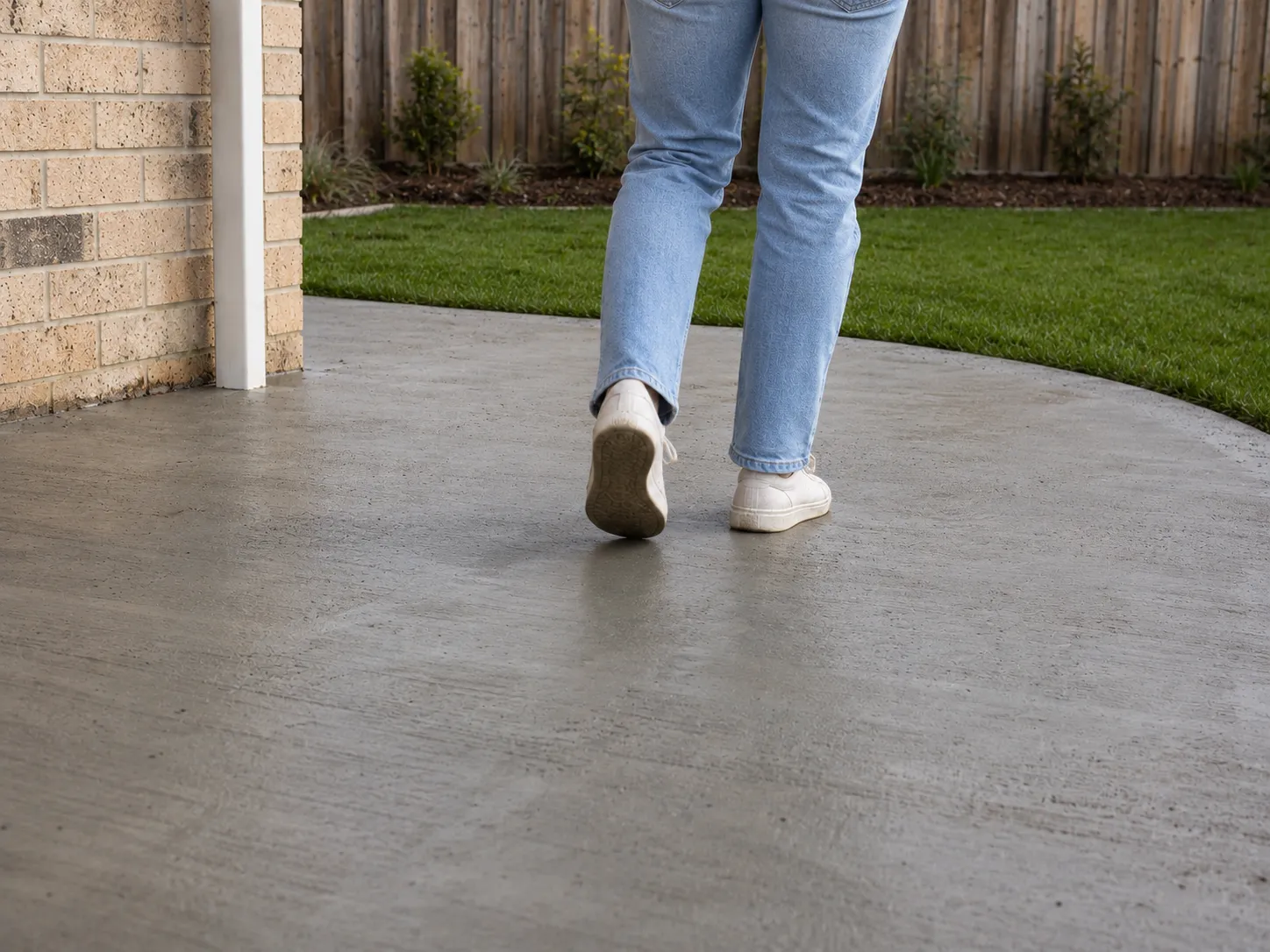
Light foot traffic is generally possible much sooner than vehicle traffic, although this does not mean the concrete is fully cured.
As a general guide:
At the 24-hour point, concrete can still be vulnerable to concentrated pressure. High heels, narrow chair legs, wheelbarrow wheels and ladders may mark or chip the finish.
It is best to limit early access to normal walking in flat shoes and avoid dragging bins, pallets, furniture or other heavy objects across the surface during the first few days.
Pets should also be kept away for at least the initial 24 hours, as claws may leave marks before the surface has developed sufficient hardness.
Cars create much greater concentrated loads than foot traffic. Under moderate conditions, a standard residential driveway is commonly left for around seven days before typical passenger vehicles are allowed onto it.
Even after this period, some care is worthwhile while the concrete continues to gain strength. During the early weeks:
Coloured, exposed aggregate or other decorative surfaces may also be more susceptible to scuffing during the early curing period. Taking additional care during the first couple of weeks can help preserve the finished appearance.
Concrete continues to develop strength for weeks after placement, with 28-day concrete strength commonly used as a reference point when specifying and assessing concrete.
As a general residential guide, light commercial vehicles and utes may be suitable after approximately 10 to 14 days where conditions and slab design allow. Heavier loads such as trucks, machinery trailers and skip bins should generally be kept off new concrete for longer, often until around the 28-day mark or until approval has been given by the contractor or engineer.
Even fully cured residential concrete may not be designed to accommodate very heavy vehicles. Removal trucks, concrete trucks, cranes and other heavy machinery can place substantial stress on slab edges and areas over softer ground. These loads should be avoided unless the driveway or slab has been specifically designed for them. The appropriate concrete driveway thickness also depends on the types of vehicles and loads the finished surface is expected to support.
New concrete often feels solid underfoot within a day, which can create the impression that it is ready for normal use. However, surface firmness does not necessarily mean the slab has developed enough strength to support vehicles or concentrated loads.
Understanding the difference between concrete setting and concrete curing helps explain why access still needs to be restricted after the surface appears hard.
Concrete goes through two related processes: setting and curing.
Setting is the initial stiffening that occurs after placement. Water reacts with cement through a chemical process called hydration, gradually changing the concrete from a workable material into a rigid mass. Within the first day, the surface may become firm enough for carefully controlled foot traffic. Understanding the difference between cement and concrete also helps explain what occurs as freshly placed concrete begins to harden.
Curing refers to maintaining conditions that allow hydration and strength development to continue. Concrete continues gaining strength over days and weeks, provided it retains sufficient moisture and is kept within suitable temperature conditions.
The rate of strength gain varies considerably depending on the mix, temperature and curing conditions. While concrete can develop a useful proportion of its eventual strength within the first several days, it is still considerably more vulnerable than it will be later in the curing period.
This is why the appearance or feel of the surface should not be used as the only indicator that concrete is ready for normal loads.
Concrete begins stiffening as hydration progresses throughout the slab. The exposed surface can feel firm relatively quickly, but this does not mean strength has developed evenly throughout the full thickness of the concrete.
At the same time, moisture can evaporate from the exposed surface, particularly in hot, dry or windy weather. Excessive moisture loss is not beneficial to curing and can increase the risk of shrinkage cracking, dusting and reduced surface durability.
This is why proper curing methods are important even after the concrete appears hard. Maintaining appropriate moisture and temperature conditions allows hydration to continue and helps the slab develop the strength and durability expected from the finished concrete.
Because fresh concrete can look and feel solid, it is easy to underestimate the effects of early loading.
Premature foot traffic may cause:
Premature vehicle traffic can create greater stresses, potentially contributing to:
Damage is not always immediately visible. Limiting early traffic and allowing appropriate curing time gives the concrete the best opportunity to develop the performance required for regular use.
There is no single curing timeframe that applies to every concrete project. How quickly a slab becomes suitable for foot traffic, vehicles or other loads depends on site
conditions, the concrete itself and its intended use.
Understanding these factors makes it easier to plan access realistically rather than relying solely on a fixed waiting period.
Temperature, moisture, wind and sun exposure can all affect how concrete develops strength.
Hot, sunny or windy conditions may cause moisture to evaporate rapidly from the surface. Although the concrete can appear to stiffen quickly, excessive drying may contribute to plastic shrinkage cracking and poor surface curing. Curing compounds, coverings or controlled moisture application may therefore be required to prevent the concrete from drying too quickly.
Cold weather has the opposite effect. Lower temperatures slow hydration and can delay early strength development. Where temperatures become very low, additional protection may be needed to maintain suitable curing conditions.
Rain shortly after placement can also affect the finished surface if the concrete has not yet set. Heavy rain can mark the surface or disturb cement paste, depending on when it occurs and how exposed the slab is.
Because Hobart can experience cool and changeable conditions, weather should always be considered when deciding whether a new driveway, patio or pathway is ready for use.
Concrete mixes do not all develop strength at the same rate. Standard residential mixes may behave differently from high-early-strength mixes or concrete containing supplementary cementitious materials.
Some projects use mixes designed to achieve early strength more quickly when access needs to be restored sooner. Other mixes may require more conservative curing periods, particularly during cooler weather.
Slab thickness can also influence temperature and moisture conditions within the concrete. However, thickness alone should not be used to decide when a slab is ready for traffic. The complete slab design, reinforcement, supporting ground, concrete specification and curing conditions all contribute to its performance.
The intended use of the concrete determines how much strength it needs before access should be allowed.
A residential footpath carrying occasional pedestrians can generally return to use earlier than a driveway carrying vehicles. Likewise, a patio supporting lightweight outdoor furniture places less demand on a slab than an area used by caravans, trailers or commercial vehicles.
Vehicle weight is not the only consideration. Sharp turning, repeated loading in one location and concentrated loads from jacks, stands or trailer jockey wheels can create high stresses even when the overall vehicle weight appears reasonable.
Using new concrete before it has developed adequate strength can increase the likelihood of cosmetic and structural damage. The severity depends on how early the concrete is used, the load applied and the curing conditions at the time.
Even relatively light loads can leave permanent marks if the surface is still soft, while heavier traffic may create stresses within the slab before it is ready to accommodate them.
Fresh concrete is particularly vulnerable at the surface. Premature use may result in:
A driveway driven on too early, for example, may develop visible scuffing where tyres turn. Furniture dragged across a young patio or wheelie bins moved over a new pathway may also mark the finish.
Once these defects have hardened into the surface, removing them may require grinding, patching or resurfacing rather than simple cleaning.
Loading young concrete before it has gained sufficient strength can contribute to cracking, particularly where the slab, supporting ground or edges are already vulnerable.
Possible problems include:
Cracks can also provide pathways for moisture to enter the concrete. Where reinforcement is present, ongoing moisture penetration may contribute to deterioration over time.
Not every early load will result in visible damage, but allowing suitable curing time reduces unnecessary stress while the slab is still developing strength.
Damage during the early curing period can affect how concrete performs over the longer term.
A poorly cured or prematurely loaded surface may be more susceptible to:
For outdoor concrete in Hobart, maintaining good curing conditions and protecting the slab from prolonged moisture, harsh weather and premature traffic can make an important difference to its long-term performance.

Fresh concrete requires careful treatment during its early curing period. Controlling access, maintaining appropriate moisture conditions and protecting the surface from weather and concentrated loads can help the slab develop properly.
Physical barriers are one of the simplest ways to prevent accidental early use.
Temporary fencing, hazard tape or cones can be placed around driveways, paths and patios to discourage visitors, delivery drivers, children and pets from entering the area.
As a general rule, foot traffic should be avoided during the first day, while vehicle access should remain restricted for considerably longer according to the project requirements.
Heavy objects should also be kept away during the early stages. Ladders with narrow feet, trailer jockey wheels, scaffolding and similar equipment can create concentrated loads capable of damaging young concrete.
Proper concrete curing helps maintain the moisture and temperature conditions needed for hydration and continued strength development. Allowing the surface to dry too quickly can reduce the effectiveness of the curing process and increase the risk of shrinkage cracking or surface weakness.
Depending on the conditions and finish, curing methods may include:
The appropriate method should be determined by the contractor because decorative, coloured and specialised concrete finishes can have different curing requirements.
Any water applied should be gentle enough to avoid damaging the surface, and coverings should be clean and installed correctly to reduce the risk of staining or uneven curing.
Hot sun and strong winds can accelerate moisture loss, while cold conditions can slow strength development. Appropriate coverings, shade or insulation may therefore be required depending on the weather.
Fresh concrete should also be protected from substances that can stain or damage its surface. Oil, petrol, paint, fertiliser, leaves and other contaminants should be kept away during the early curing period.
Heavy equipment and concentrated point loads should also be avoided. Where access cannot be prevented later in the curing period, suitable boards or sheets may sometimes be used to distribute loads, but this should not be treated as a substitute for allowing adequate curing time.
Giving fresh concrete enough time to cure is one of the most effective ways to protect its strength, appearance and long-term durability. Light foot traffic may generally be possible after about 24 hours, while passenger vehicles often need to remain off a new residential driveway for around seven days. Heavy loads can require substantially longer, with the appropriate timeframe depending on the concrete mix, slab design, weather and intended use.
These timeframes should always be treated as general guidance rather than fixed rules. Advice from the concreter, supplier or engineer responsible for the project should take priority because they can account for the actual mix, site conditions and loading requirements.
Con-Tek Concrete understands that proper curing and careful early use are just as important as the quality of the initial pour. By controlling access, maintaining suitable curing conditions and protecting the surface from unnecessary loads and harsh weather, property owners can reduce the risk of premature damage and help their driveway, patio, path or slab perform reliably for years to come.
