CALL US TODAY

Concreters you can trust.
CALL US TODAY
Choosing the correct thickness for a concrete driveway is one of the most important decisions in achieving long-term durability and performance. While slab depth matters, it is only one part of the overall design. Vehicle loads, soil conditions, reinforcement, drainage and base preparation all influence how well a driveway performs over time.
For homeowners comparing concreters in Hobart, understanding driveway thickness, site conditions and reinforcement can make it easier to choose a driveway designed for daily use and long-term performance. Con-Tek Concrete recognises that every driveway needs a balanced approach rather than relying on a single standard measurement.
This article explains the standard thickness recommendations for residential concrete driveways, when thicker slabs are required and why proper base preparation is essential for creating a driveway that can support regular use.
Most residential concrete driveways are built between 100 mm and 150 mm thick, depending on how the driveway will be used. For a typical home that only sees passenger cars and light SUVs, a 100 mm slab is widely accepted as the minimum standard when placed over a properly compacted base.
In many cases, a 125 mm slab may be recommended for added durability, particularly where the driveway will experience frequent traffic, heavier family vehicles or less predictable ground conditions. For heavier loads, such as caravans, trailers, work utes or occasional delivery vehicles, a 125 mm to 150 mm slab may be more suitable.
The right thickness depends on the types of vehicles using the driveway and the condition of the ground beneath it. A slab that is too thin may be more likely to crack or settle, while a slab that is much thicker than needed can increase costs without providing practical value.
For driveways used only by standard passenger vehicles, a 100 mm thick concrete slab placed over a properly compacted subbase is generally suitable. This thickness provides enough strength for everyday vehicles such as sedans, small SUVs and light utes when the concrete mix, reinforcement and base preparation are appropriate.
A 125 mm slab may be worth considering when the driveway will be used frequently, when larger family vehicles are common or when the site conditions are less stable. This added thickness can provide better resistance to cracking and surface wear, especially where vehicles brake, turn or park in the same areas each day.
A 125 mm slab may also be considered where:
For most residential driveways, 100 mm is the practical minimum, while 125 mm provides a more robust standard where extra durability is needed.
A thicker slab becomes important when the driveway will support anything heavier than normal passenger vehicles. Extra thickness helps the driveway resist flexing, cracking and settlement under higher loads.
Driveways may need to be increased to 125 mm or 150 mm where they are used by:
In some cases, the entire driveway may not need to be thicker. High-stress areas such as street crossovers, garage entries, turning areas, parking bays and load points may benefit from local thickening. This allows the driveway to be strengthened where it needs it most without overbuilding the entire slab.
If thickness changes are used in selected areas, they need to be carefully planned. Poorly designed transitions can create weak points, uneven edges or trip hazards.
Driveway thickness is only effective when the concrete is supported by a stable base. Even a 150 mm slab can fail if it is placed over soft, loose or poorly compacted soil. A well-prepared base supports the concrete evenly, helps manage moisture and reduces movement beneath the slab.
Concrete performs well under compression but is less effective when it bends or flexes. If the ground beneath the slab contains soft spots or voids, sections of the driveway can settle at different rates. This creates stress in the concrete and often leads to cracking, lifting or sinking.
A properly prepared base helps provide:
Typical preparation may include removing topsoil and organic material, trimming the subgrade, compacting the natural ground and installing a layer of crushed rock or road base. The aim is to create a firm, even platform before concrete is poured.
Soil conditions play a major role in driveway performance. Soft, reactive or poorly drained soils can move under load or change volume as moisture levels rise and fall. This movement transfers directly into the concrete and increases the risk of cracking.
Extra attention is often needed where the site has:
On sloping driveways, vehicles often brake, turn and accelerate more aggressively. This increases stress on the surface, particularly near garage entries, carports, tight corners and reversing areas. These sections may justify added slab thickness, stronger reinforcement or more careful joint planning.
In many cases, proper base preparation and drainage will provide more real-world durability than simply increasing the slab thickness.
Water is one of the most common causes of driveway problems. When water sits beneath or beside the slab, it can soften the subgrade, wash fine particles out of the base and create voids beneath the concrete. Over time, this can lead to settlement, cracking and uneven surfaces.
Good driveway design should direct water away from the slab and surrounding structures. The driveway should have appropriate fall so water does not pond on the surface or drain back towards the house, garage or landscaping.
Base preparation also assists with moisture control. A compacted granular base allows incidental moisture to move more effectively than soft soil or poorly compacted fill. This helps reduce the risk of water becoming trapped beneath the concrete.
In Hobart and other cooler areas, driveways may also need to account for seasonal moisture and temperature changes. Where frost exposure is a genuine site concern, the concrete mix and drainage design should be selected to suit those conditions.
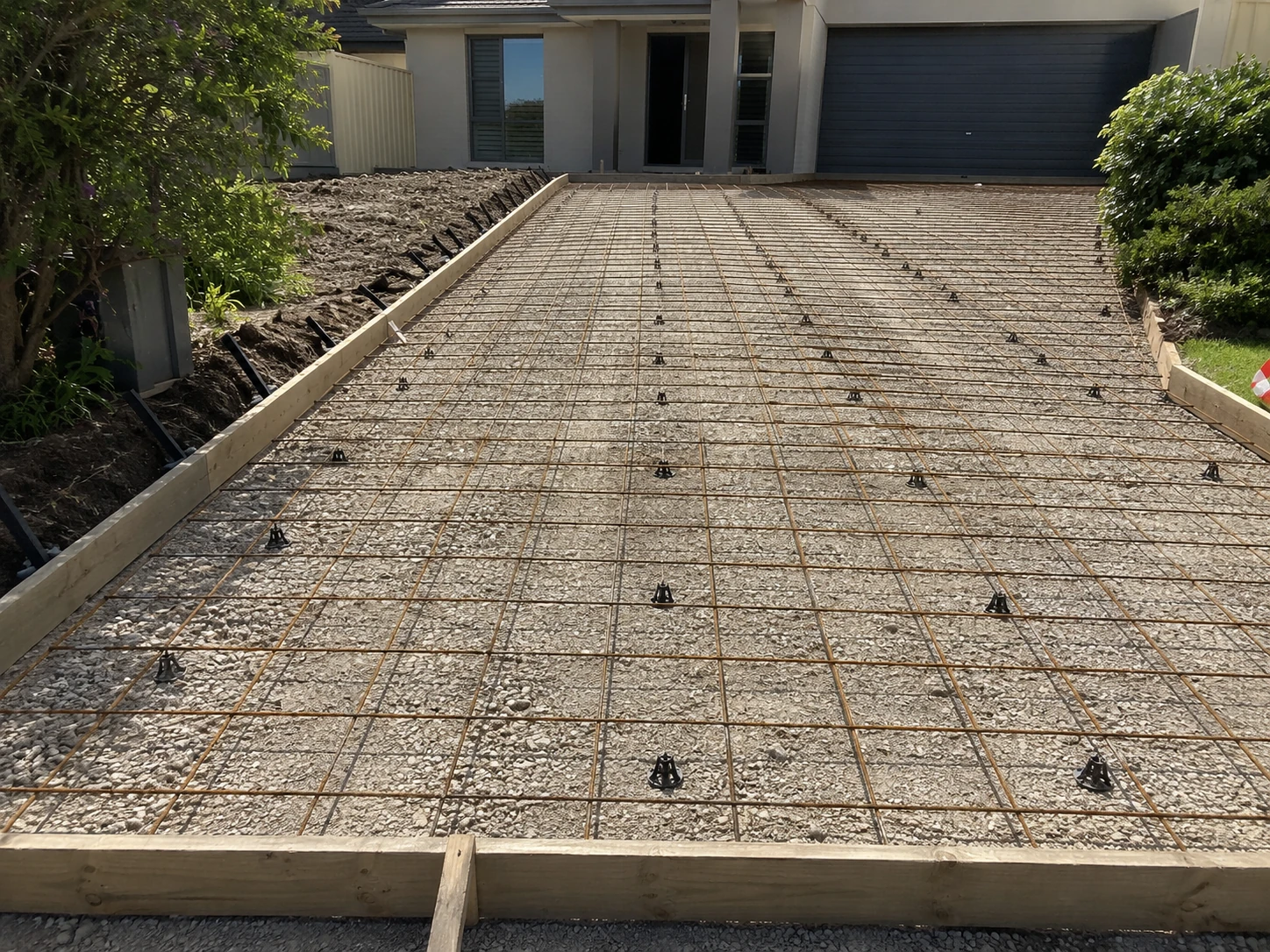
Reinforcement is not always mandatory for every residential driveway, but it is often recommended. Its main purpose is to help control cracking, improve load distribution and hold the slab together if movement occurs.
Reinforcement does not make concrete completely crack-free. All concrete has the potential to develop shrinkage cracks or fine surface cracks over time. However, well-placed reinforcement can help keep cracks tighter and reduce the risk of uneven movement between sections of the slab.
Reinforcement becomes particularly important where:
Steel mesh is commonly used in residential concrete driveways. The mesh must be placed at the correct height within the slab, usually supported on bar chairs, so it can perform as intended. Mesh that sits directly on the ground or base provides little benefit.
For heavier-use driveways, reinforcing bars may be used in a grid pattern, particularly where higher loads or greater ground movement are expected. This may be suitable for thicker slabs, parking areas, street crossovers or load-bearing sections.
Fibre reinforcement may also be used in some driveway mixes. Microfibres can help reduce early plastic shrinkage cracking, while structural macrofibres may improve tensile performance. Fibre reinforcement should be chosen carefully and should not automatically be treated as a full replacement for steel reinforcement in higher-load situations.
The best reinforcement option depends on the slab thickness, vehicle loads, site conditions and joint layout.
Reinforcement does not remove the need for control joints. Joints are used to encourage concrete to crack in planned, controlled locations as it shrinks. Without proper joints, cracks are more likely to appear randomly across the slab.
A well-designed driveway uses joint spacing, reinforcement and slab thickness together. Control joints should generally divide the driveway into practical panels that are as close to square as the layout allows. Long, narrow panels or poorly placed joints can increase the risk of random cracking.
For a standard 100 mm residential driveway, joints are often placed at regular intervals of around 2.5 to 3 metres, depending on the layout and site conditions. The exact spacing should be planned before the concrete is poured.
Driveway thickness is only one part of the final design. A durable driveway also depends on the concrete strength, subgrade condition, reinforcement, drainage, slope, jointing and how the driveway will be used.
Important design factors include:
Edges and entry points often need extra attention because they are more vulnerable to chipping, cracking and repeated wheel loads. Areas around drainage grates, service covers and garage thresholds may also require careful detailing to avoid weak points.
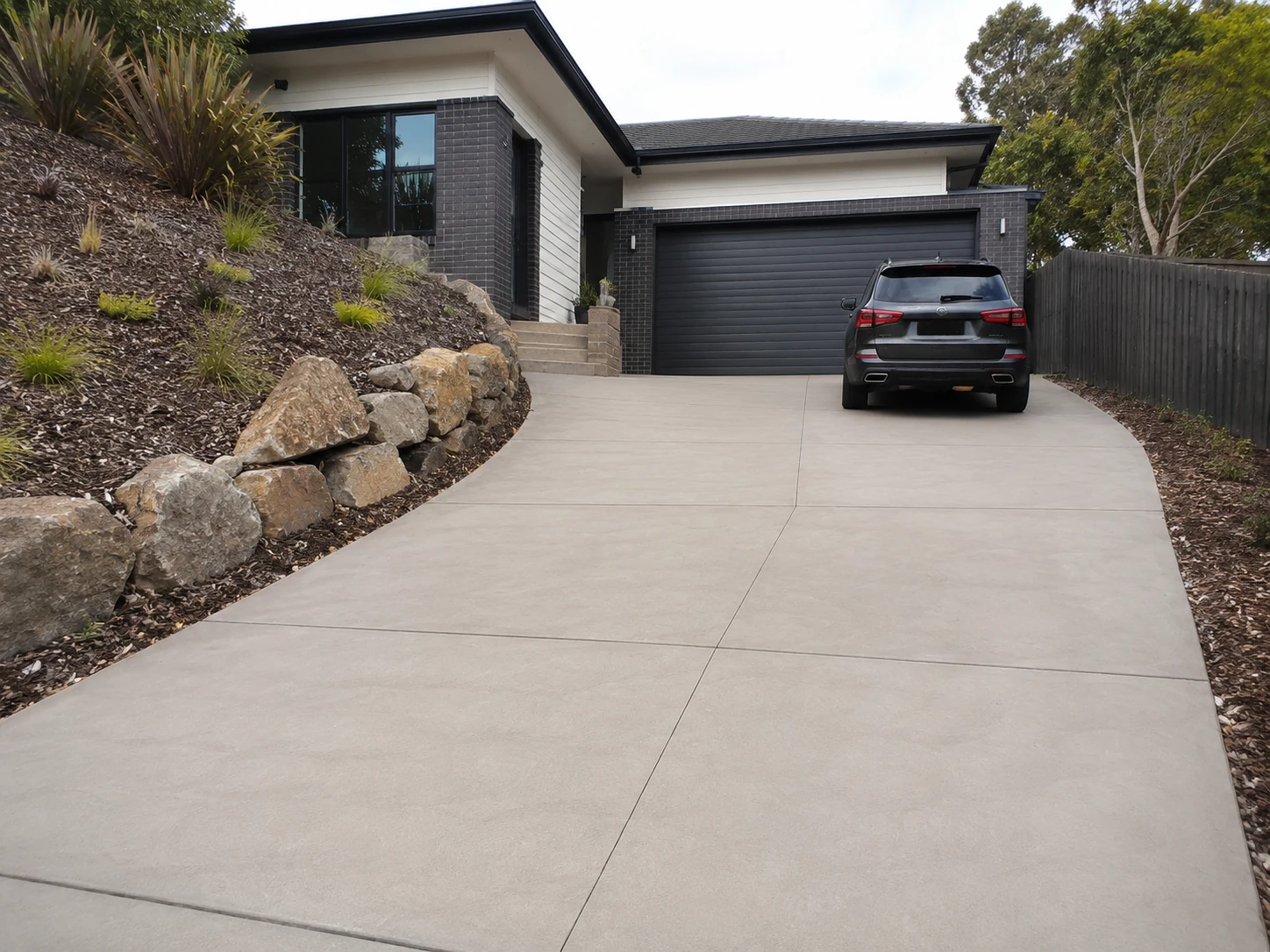
Correct driveway design should be decided before any concrete arrives on site. Once the concrete is poured, changing the slab thickness, reinforcement, drainage or joint layout becomes difficult and expensive.
The first step is to be clear about what the driveway needs to support. A driveway used only for passenger vehicles may perform well at 100 mm with a suitable base and reinforcement. Where regular use by larger vehicles, trailers or work utes is expected, 125 mm may be more appropriate. For heavier loads or high-stress areas, 150 mm may be required.
The concrete strength should also suit the intended use. Many residential driveways use a 25 MPa or 32 MPa mix, depending on the project requirements. Higher-strength concrete may be suitable for heavier-use areas, but strength alone will not compensate for poor base preparation, bad drainage or unsuitable jointing.
Before the pour, the site should be assessed for ground stability, moisture, levels and access. Any soft spots, organic material or poorly compacted fill should be addressed before the slab thickness is finalised.
Selecting the right concrete driveway thickness is a technical decision that should reflect expected vehicle loads, site conditions, climate and construction methods rather than relying on one standard measurement alone.
For many residential driveways, 100 mm is suitable for everyday passenger vehicles when installed over a sound base. Where heavier traffic, reactive soils, sloping sections or high-use areas are involved, 125 mm to 150 mm may be more appropriate.
The strongest result comes from planning the slab thickness, reinforcement, base preparation, drainage and joint layout together. When these elements are properly considered before the concrete is poured, the driveway is more likely to deliver long-term durability, reduced maintenance and reliable performance.
